
Predictive Loyalty: Spotting At-Risk Customers Before They Leave


Customer churn in ecommerce is rarely sudden. The customer who places their last order today did not, in most cases, make a spontaneous decision to stop purchasing. They drifted — gradually reducing their engagement, responding less to communications, visiting the site less frequently, and eventually stopping entirely. The decision to leave, when it is made consciously at all, is usually the last step in a process of disengagement that began weeks or months earlier and that left a trail of signals that a retailer with the right analytical tools could have detected and acted on.
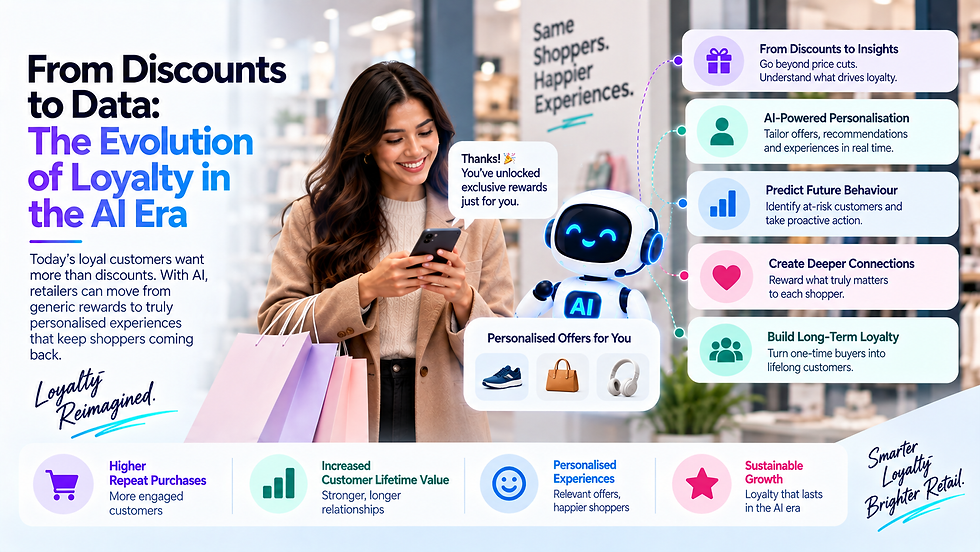
Predictive loyalty is the capability to read those signals — to identify, from the patterns in customer behaviour, the customers who are in the early stages of disengagement and whose trajectory, if unchanged, leads to churn. It is the difference between reactive retention — responding to customers who have already stopped purchasing with win-back campaigns that have limited effectiveness — and proactive retention — intervening while the customer is still engaged enough to be influenced.
The commercial significance of this difference is large. Win-back campaigns for churned customers typically achieve conversion rates of five to ten percent. Retention interventions for at-risk customers who have not yet disengaged fully typically achieve rates of twenty to forty percent. The customer who has drifted but not left is far more recoverable than the one who has already gone — and far cheaper to recover, because they do not require the acquisition-level investment that win-back typically demands.
What At-Risk Actually Looks Like
The Disengagement Pattern
Customer disengagement in ecommerce follows recognisable patterns that differ by customer type, purchase category, and the length and depth of the customer relationship. For a customer who has historically purchased monthly, the at-risk signal might be a single missed purchase cycle combined with a decline in email open rates. For a customer who purchases infrequently, the same missed cycle is normal behaviour rather than a warning signal. Predictive loyalty models need to be calibrated to individual customer behaviour baselines rather than population averages — what is abnormal for this customer, given their history, rather than what is below average for customers in general.
The behavioural signals that most reliably predict churn include purchase frequency decline relative to personal baseline, session frequency and depth decline, email and app engagement decline, reduction in average order value, and the absence of the category-specific behaviours associated with continued purchase intent. None of these individually is a reliable churn predictor — customers take holidays, face financial pressures, and have periods of lower engagement that do not lead to churn. In combination, and calibrated to individual baseline, they are considerably more predictive.
The Early Warning Signals
The signals that predict churn earliest — before the disengagement pattern is fully established — tend to be the most subtle and the most valuable. A customer who begins a session, navigates to the returns page, and exits without browsing products may be exhibiting an early disengagement signal — passive resolution focus rather than purchase intent. A customer whose session time in a specific category that has historically driven their purchases declines even while overall session frequency remains stable may be beginning to shift their purchasing to a competitor in that category. A customer who opens promotional emails but does not click through is exhibiting a specific disengagement pattern that differs from the one where they stop opening emails entirely.
Identifying these early signals requires analytical granularity that goes beyond the monthly reporting cycles through which most loyalty and retention teams review customer metrics. The customer who is two months from churning is best identified at two months, not at one week. The earlier the detection, the more options are available for intervention and the lower the cost of retention.
How Predictive Models Work
Feature Engineering for Churn Prediction
Predictive churn models are trained on the historical behaviour of customers who have churned — building a profile of the behavioural patterns that preceded churn in past cases and using that profile to score current customers by their similarity to the pre-churn pattern. The quality of the churn prediction depends critically on the quality and relevance of the features used to build the model.
The most predictive features for ecommerce churn consistently include recency (how long since the customer last purchased), frequency (how their purchase rate has changed over time), monetary trend (how their spend is trending relative to their personal baseline), engagement trend (how their site, email, and app engagement has changed), category behaviour (whether they are purchasing across categories or narrowing to a single category that may be commoditised), and service interaction patterns (whether they have had service contacts that were resolved unsatisfactorily). Models that incorporate all of these dimensions outperform those that rely on any single dimension.
Propensity Scoring at Scale
Once a churn prediction model is trained, it produces a churn propensity score for each customer — a probability estimate that reflects the likelihood of that customer churning within a defined time horizon. These scores are updated continuously as new behavioural data is generated, so the model's prediction for each customer reflects their most current state rather than a historical snapshot.
The practical output of propensity scoring is a prioritised list of at-risk customers — ranked by their churn probability and, ideally, by the estimated value of their retention — that enables the retention programme to focus its intervention resources on the customers whose retention is both achievable and commercially significant. Not every at-risk customer warrants an intervention investment. The predictive loyalty programme that prioritises by both risk and value achieves better commercial outcomes than one that targets all at-risk customers equally.
Intervention Design by Risk Profile
Different at-risk profiles warrant different interventions. The customer who is in the early stages of disengagement — declining email engagement, reduced session frequency, but still purchasing at their normal rate — is best served by a relevance intervention:
personalised content or offers calibrated to their specific interests, designed to re-establish the habit of engagement before purchase frequency declines. The customer who is in the middle stage of disengagement — reduced purchase frequency, increased service contacts, declining average order value — may need a more direct retention incentive alongside a service quality improvement that addresses the source of their dissatisfaction. The customer who is in the late stage of disengagement — no purchase in the last two cycles, very low engagement — may need a re-engagement campaign that reminds them of their relationship with the brand and provides a compelling reason to return.
Measuring Retention Programme Effectiveness
The Control Group Problem
Measuring the effectiveness of retention interventions is more complex than it appears, because some percentage of at-risk customers would have returned without any intervention. A retention campaign that achieves a twenty percent response rate has not necessarily retained twenty percent of at-risk customers — it has retained the customers who responded, some of whom would have returned anyway, and it has not retained the customers who did not respond, some of whom would not have left. Properly measuring retention programme effectiveness requires control groups — at-risk customers who receive no intervention, against whose subsequent behaviour the treatment group can be compared.
This measurement rigour is worth the investment because it enables continuous improvement of both the prediction model and the intervention design. Retention programmes that measure carefully learn which customer profiles respond to which interventions, and can refine their targeting and messaging accordingly. Those that measure crudely continue to invest in interventions whose true effectiveness they do not understand.
Lifetime Value Impact
The ultimate measure of a predictive loyalty programme is its impact on customer lifetime value — not just whether it retains customers in the short term, but whether the retained customers go on to deliver the value that made their retention commercially worthwhile. A retention programme that preserves the customer relationship but does not restore the engagement level that made that relationship valuable has achieved less than it appears. The goal is not retention per se but the restoration of the purchasing and engagement behaviour that makes the retained customer relationship commercially significant.
Conclusion
Most customer churn in ecommerce is predictable. The signals are there — in purchase frequency, engagement patterns, session behaviour, and service interaction — weeks or months before the customer places their last order. Predictive loyalty programmes read those signals, score every customer by their churn risk, and enable interventions that reach at-risk customers while they are still engaged enough to be retained. The retailers that build this capability are not just reducing churn — they are changing the fundamental economics of customer retention, shifting the investment from expensive win-back to cost-effective proactive retention at the moment when it is most likely to work.
The best time to retain a customer is before they have decided to leave. Predictive loyalty gives you the intelligence to act at that moment — not the one after it.


Comments