
From Discounts to Data: The Evolution of Loyalty in the AI Era

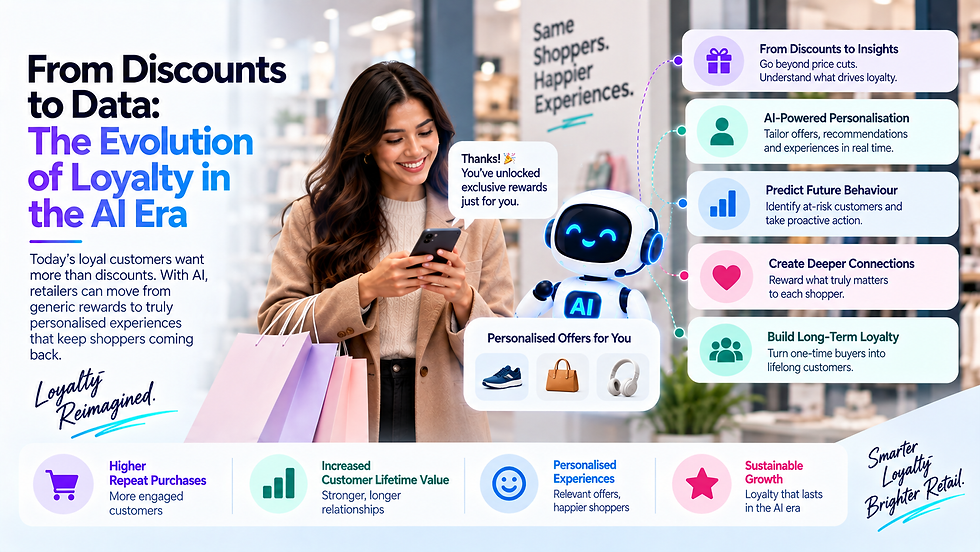
The standard retail loyalty programme was built on a simple transaction: the customer gives the retailer data about their purchase behaviour, and in exchange the retailer gives the customer points that eventually convert to discounts. Both parties got something from the arrangement. But the arrangement was always lopsided in ways that have become increasingly apparent as customer expectations and analytical capabilities have both evolved.
The retailer got purchase data. The customer got a delayed discount. The retailer used the data to understand aggregate purchase patterns and to drive incremental visits through points redemption mechanics. The customer remained largely anonymous in their specific preferences, needs, and loyalty motivations — they were a member with a points balance, not a known individual with a understood relationship.
AI is changing this arrangement at its foundation. Not by eliminating discounts — points and rewards remain commercially effective tools in the right context — but by expanding what loyalty programmes can be, what they can know about individual customers, and what they can offer beyond the standard rewards currency. The shift is from loyalty as a purchase incentive scheme to loyalty as a genuine relationship infrastructure — one that understands each customer individually, provides value that goes beyond price reduction, and creates the kind of personal relevance that makes switching to a competitor feel like a genuine loss rather than an indifferent migration.
What Was Wrong With the Old Model
Identical Treatment for Different Customers
Traditional loyalty programmes treated all members as equivalent within their tier — every Gold member received the same communications, the same offers, and the same rewards regardless of how different their individual purchase patterns, preferences, and relationship motivations actually were. The Gold member who shopped primarily for homewares received the same fashion promotion as the one who shopped primarily for fashion. The member who responded best to early access offers received the same discount voucher as the one who was primarily motivated by status recognition.
This uniformity was not a design failure — it was a technical limitation. Without the analytical capability to understand individual customer preferences at scale and to generate individually tailored communications and offers, uniform treatment by tier was the practical ceiling. AI removes this ceiling.
Reactive Churn Management
Traditional loyalty programmes typically managed churn reactively — identifying customers who had lapsed (whose last purchase exceeded a defined recency threshold) and attempting to reactivate them with promotional incentives. By the time a customer had lapsed to the threshold, their loyalty had usually already eroded to the point where reactivation was both expensive and uncertain. The promotional offer that was required to reactivate a lapsed customer was typically larger than the investment that would have been required to retain them before they lapsed.
AI loyalty systems that model churn risk continuously — monitoring the behavioural signals that precede disengagement before it reaches the lapse threshold — enable intervention at the point where it is most effective and least costly. The customer who is showing early disengagement signals receives a targeted retention engagement before they have lapsed, not after.
Points as the Primary Value Proposition
Points are a commodity. Every major retailer has a points programme. Every major retailer offers broadly similar points-to-discount conversion rates for broadly similar earning behaviours. The customer who joins one retailer's loyalty programme for the points has the same incentive to join every other retailer's programme — and in practice, most regular shoppers are members of multiple programmes simultaneously, making loyalty to any single programme a function of which programme currently offers the best points deal rather than which brand has the strongest relationship with the customer.
AI loyalty programmes that can offer genuinely personalised value — experiences, early access, product recommendations, and services that are calibrated to the individual customer's specific interests — create loyalty value that is not replicable across programmes. A customer who values their loyalty relationship because it provides them with product discovery that is precisely calibrated to their taste, early access to the categories they care about, and proactive service for the issues they are most likely to encounter has a relationship that is harder to replicate by accumulating equivalent points elsewhere.
What AI Makes Possible in Loyalty
Individual-Level Understanding at Programme Scale
The fundamental capability that AI brings to loyalty programmes is the ability to build and act on individual-level customer understanding at the scale of a full programme membership — not for the segment of high-value customers who receive dedicated account management, and not through the crude segmentation of tier-based programmes, but for every member individually.
AI loyalty systems that process each member's full interaction history — purchases, browsing behaviour, service interactions, engagement with loyalty communications, response to previous offers, product return patterns — build an individual model of each member that informs every dimension of their programme experience: what communications they receive, what offers they are shown, what recommendations are surfaced, and what the programme's response to their behaviour looks like.
This individual-level understanding is what enables the shift from a programme that treats members as segment representatives to one that treats them as known individuals — a shift that produces materially different engagement rates, redemption rates, and retention outcomes.
Predictive Personalisation
AI loyalty programmes can predict what individual members will want before they have expressed it — surfacing product recommendations at the point when they are most likely to be relevant, sending communications at the moments when engagement is highest, and presenting offers that are calibrated to the specific motivations that have driven the member's past behaviour.
A member who consistently purchases seasonal items early — who buys autumn clothing in August and Christmas gifts in October — can receive early access offers at exactly the moments they are behaviorally most receptive to them, without the retailer having to wait for the member to initiate a shopping visit. Predictive personalisation converts the loyalty programme from a reactive communications system into a proactive relationship management capability.
Loyalty Beyond Transactions
AI enables loyalty programmes to provide value that extends beyond the transaction — creating touchpoints that deepen the relationship without requiring a purchase. Personalised product guidance for a member who has expressed interest in a new category. Service follow-up that checks on a member's experience with a recent purchase. Content that is relevant to the member's expressed interests and lifestyle beyond their purchase history. Community features that connect members with shared preferences.
These non-transactional value dimensions are commercially significant because they increase the frequency and depth of engagement — creating a programme that members interact with not just when they are ready to buy but throughout the lifecycle of their relationship with the brand. Higher engagement frequency produces higher top-of-mind awareness, which produces a higher share of the member's category spending — independently of the discount value the points represent.
Dynamic Loyalty Mechanics
AI enables loyalty programme mechanics to be dynamic rather than fixed — adapting earn rates, recognition thresholds, and offer structures to the individual member's behaviour and to the retailer's current business objectives simultaneously. A member who is approaching a tier threshold can receive a targeted earn bonus that accelerates their progression at the moment when it is most motivating. A member whose behaviour signals that they are comparison shopping can receive an offer that reflects the specific value that would be most likely to retain their share of spend.
Dynamic mechanics produce loyalty investment efficiency gains alongside improved member experience — concentrating loyalty currency and incentive spend on the moments and members where it changes behaviour, rather than distributing it uniformly across behaviours that would occur regardless of the incentive.
The Data That Makes AI Loyalty Possible
AI-powered loyalty requires a richer and more integrated data foundation than points-programme loyalty management. Purchase data is the baseline — but it is insufficient alone. Browsing behaviour, channel engagement, service interaction history, content engagement, third-party intent signals, and the real-time context of each interaction are all inputs to the individual customer model that makes AI loyalty personalisation meaningful.
The retailers who are advancing most effectively in AI loyalty are those who have invested in the customer data infrastructure that connects these sources — building a unified customer record that integrates data from the ecommerce platform, the CRM, the loyalty programme platform, the customer service system, and the marketing stack. Without this integration, AI loyalty systems are constrained to the same data that traditional programmes used, and the personalisation they can offer is correspondingly limited.
Conclusion
The loyalty programme that was defined by points and discounts served its commercial purpose in a world where understanding customers individually at scale was not technically achievable. That world has changed. AI makes individual-level customer understanding achievable at full programme scale — which means the loyalty programme that competes on points alone is now competing at a disadvantage against programmes that offer genuine, personalised, relationship-level value.
The shift from discounts to data is not an abandonment of rewards mechanics. It is an expansion of what loyalty can mean — from a purchase incentive system to a genuine relationship infrastructure that understands each customer, anticipates their needs, and provides value that makes the programme worth belonging to for reasons beyond the points balance.
A points balance is a reason to shop. A programme that understands you is a reason to stay. AI is what makes the difference between the two.


Comments