
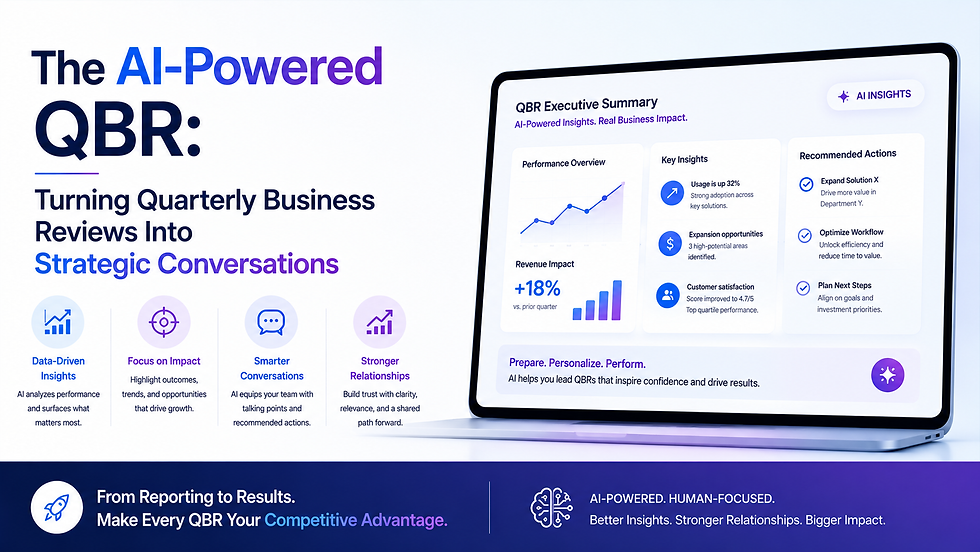
The AI-Powered QBR: Turning Quarterly Business Reviews Into Strategic Conversations

The quarterly business review has become, in many organisations, a ritual of preparation that consumes more value than the meeting itself creates. Account managers spend days assembling slide decks — pulling usage data from one platform, support history from another, commercial metrics from a third, and weaving them together into a narrative that is usually backward-looking, frequently incomplete, and structurally designed to avoid the conversations that would genuinely serve the customer rather than the ones that are easiest to control.
The customer experience of the QBR is not much better. They receive a presentation about their own product usage that they could have accessed themselves, a summary of support tickets they were personally involved in resolving, and an account team that is trying to demonstrate engagement through the thoroughness of their slide preparation rather than through the quality of their strategic thinking.
What should happen in a QBR is a strategic conversation — one grounded in an accurate, complete picture of how the product is performing against the customer's actual business outcomes, where gaps or opportunities exist, and what the account team is recommending for the next quarter based on that picture. This conversation requires intelligence that the slide-deck preparation process cannot reliably produce at the depth required, because it requires synthesising data across too many sources, interpreting it in the context of the customer's business objectives, and forming views that go beyond description of what has happened to assessment of what it means.
AI changes what is possible in QBR preparation — not by adding another data source to compile but by synthesising across all of them, identifying the patterns and insights that matter, and enabling the account team to arrive at the QBR already holding the strategic intelligence they need to have a genuinely valuable conversation.
What the QBR Preparation Process Currently Looks Like
In most account management operations, QBR preparation follows a recognisable pattern. The account manager pulls the report from the product analytics platform. They run a query in the CRM for the deal history. They review the support ticket log for notable issues. They look at the usage dashboards. They compile these elements into a presentation structure that has been standardised across the team, fill in the placeholders with the account's specific numbers, and add a few slides of forward-looking content about product roadmap items or account growth opportunities.
The preparation takes two to three days for a thorough job on a complex account. The resulting presentation is largely a data aggregation exercise. The insights it contains are the ones that were visible in the individual data sources — which means they are the insights that a careful account manager with enough time could have extracted manually.
What it cannot contain — because the preparation process has no mechanism for producing it — is the cross-source pattern analysis that reveals how the customer's usage trajectory is diverging from the benchmark of accounts with similar profiles, or the early signal from support interaction sentiment that indicates a satisfaction decline that has not yet appeared in NPS scores, or the specific correlation between a product adoption gap and the customer's stated business objective that, if addressed, would produce a significant outcome improvement.
What AI Brings to QBR Preparation
Cross-Source Intelligence Synthesis
AI synthesis of QBR intelligence operates across the full data landscape that is relevant to the account — product usage, support history, commercial metrics, communication logs, external business news, benchmark comparisons against similar accounts — and produces an integrated picture that is significantly more revealing than any single source.
The finding that a customer's usage of feature X has declined by forty percent over the past quarter is a data point. The finding that this decline coincides with the departure of the internal champion who was the primary user of that feature, that the replacement contact has not yet engaged with that feature area, and that accounts in similar situations typically recover adoption within eight weeks if proactive enablement support is provided — this is an actionable intelligence finding that changes what the QBR conversation should address. AI can produce the second. Manual data compilation reliably produces only the first.
Outcome Gap Identification
Every customer had objectives when they purchased. They wanted to achieve specific business outcomes — cost reduction, efficiency improvement, revenue growth, risk mitigation — and they invested in the product as a means toward those outcomes. The QBR conversation that addresses whether those outcomes are being achieved, where they are falling short, and what changes would close the gap is a strategically valuable conversation. The QBR conversation that reviews usage statistics without connecting them to the outcomes they were intended to produce is not.
AI QBR preparation connects usage data to outcome objectives — identifying where product utilisation is strong enough to be delivering on the customer's stated goals and where utilisation gaps correlate with outcome gaps that the account team should address. This requires integrating the initial onboarding objectives documentation, the usage data, and the customer's communication history to form a view of outcome achievement that the account team can present not as a data review but as a business performance assessment.
Forward-Looking Recommendations
The most commercially valuable section of any QBR is the forward-looking one — the account team's view of what the customer should prioritise in the coming quarter and why. This section is also the one that receives the least rigorous preparation in most QBR processes, because forming a genuinely evidence-based view of what the customer should do next requires exactly the kind of cross-source intelligence synthesis that AI enables.
AI-generated forward-looking recommendations for QBRs are based on the outcome gap analysis, the expansion signals present in the account's current behaviour, the success patterns of comparable accounts, and the product roadmap items that are most relevant to the customer's current situation. The account team that arrives at a QBR with an AI-synthesised recommendation that is specific, evidence-based, and grounded in the customer's own data has a fundamentally more valuable conversation to offer than the one presenting a generic roadmap overview.
Conversation Preparation: Questions and Risk Identification
Beyond the content of the QBR, AI can prepare the account team for the conversation itself — identifying the topics the customer is most likely to raise, the concerns that the data suggests may be present even if they have not been explicitly stated, and the questions that the account team should be asking to surface the strategic agenda the customer is bringing to the meeting.
Risk identification in QBR preparation is particularly valuable. AI systems that identify early satisfaction decline signals, usage drops that correlate with churn risk, or relationship health concerns — and surface these as conversation preparation notes rather than as slide content — give the account team the awareness to manage these risks proactively rather than being surprised by them in the meeting.
Changing the Meeting Itself
When AI changes what the account team knows before walking into the QBR, it changes the nature of the meeting. The account team that has already synthesised the relevant data and formed views about what it means can spend the meeting time in dialogue rather than in presentation. They can ask more questions rather than making more statements. They can engage with the customer's strategic agenda rather than defending their own slide content.
This shift in meeting dynamic is what separates a genuinely strategic QBR from a reporting session with a nice slide template. The customer who leaves a QBR feeling that the account team has genuinely grappled with their business situation, formed intelligent views about where they should be going next, and engaged with their own strategic priorities in an informed way has had a qualitatively different experience from the customer who left having watched forty-five minutes of data presentation.
The downstream effect on retention and expansion is measurable. QBRs that are experienced as strategically valuable increase the account team's perceived relevance, reduce the competitive pressure on renewal, and create the trust and rapport that expansion conversations require. QBRs that are experienced as administrative obligations reduce perceived relevance, invite competitive comparison, and produce the 'can we just do this over email next time?' response that signals a relationship that is not growing.
The Preparation Time Dividend
One of the most immediate practical benefits of AI-powered QBR preparation is the time it returns to account managers. The two to three days that a thorough manual QBR preparation currently consumes is time that is not available for customer conversations, pipeline development, or the relationship maintenance that drives retention and expansion.
AI that handles the data aggregation and synthesis layer of QBR preparation does not eliminate the account manager's role — it eliminates the data compilation work and returns the saved time to the human judgment layer: the review of AI-generated intelligence, the addition of relationship context that the AI cannot access, the preparation for the conversation itself, and the strategic thinking about what the account team is actually recommending and why.
Conclusion
The QBR is one of the highest-potential moments in the account management lifecycle — a scheduled, high-attention meeting where the account team has the customer's focus and the mandate to address the full scope of the relationship. The question is whether the account team arrives at that moment holding data they assembled by hand, or intelligence they can think from.
AI makes the second possible — at the depth and breadth that transforms the QBR from a reporting ritual into a strategic dialogue that serves the customer's actual interests and advances the commercial relationship.
The QBR that is worth the customer's time is not the one with the most complete data. It is the one with the most relevant thinking. AI is how the preparation gets to thinking.


Comments